Addressing the Top Three Dog Behavioral Problems with In-Home Professional Training

Dogs are cherished companions, bringing joy, loyalty, and love to millions of households. However, even the most devoted pet owners can face challenges when their dogs exhibit behavioral issues. According to veterinary and training experts, the top three concerns with dog behavioral problems are aggression, separation anxiety, and excessive barking.
 
 
These issues can disrupt the harmony of a home, strain the bond between pet and owner, and, in severe cases, lead to safety concerns or rehoming. Fortunately, in-home professional dog training offers tailored, effective solutions to address these problems, fostering a stronger relationship between dogs and their owners. This article explores these prevalent behavioral issues and highlights how in-home professional trainers can provide customized, compassionate interventions to resolve them.Aggression: A Serious Concern Requiring Expert InterventionAggression is one of the most concerning canine behavioral issues, often cited as the primary reason dogs are surrendered to shelters.
 
Aggression can manifest in various forms, including growling, biting, lunging, or resource guarding, and may be triggered by fear, territorial instincts, or lack of socialization. The Merck Veterinary Manual notes that aggression accounts for approximately 70% of cases in referral practices across North America, underscoring its prevalence and severity. Left unaddressed, aggressive behavior can escalate, posing risks to people, other pets, and the dog itself.In-home professional trainers are uniquely equipped to tackle aggression because they work directly in the dog’s environment, where triggers are most likely to occur. Unlike group classes, in-home sessions allow trainers to observe the dog’s behavior in real-world contexts—such as reacting to visitors at the door or guarding food in the kitchen.
 
 
Certified trainers, such as those accredited by the Certification Council for Professional Dog Trainers (CCPDT), use positive reinforcement techniques to build trust and confidence in the dog. For example, they may employ desensitization and counter-conditioning to gradually reduce a dog’s reactivity to specific stimuli, like strangers or other animals. By identifying the root cause—whether fear, anxiety, or learned behavior—trainers develop customized plans that address the dog’s emotional needs while teaching owners how to reinforce calm, non-aggressive responses.In-home training also ensures safety and consistency.
 
Trainers can guide owners on managing aggressive behaviors, such as using muzzles during initial sessions or teaching commands like “leave it” to redirect attention. This hands-on approach empowers owners to maintain progress between sessions, ensuring long-term behavior modification. For instance, Bark Busters, a leader in in-home dog training, emphasizes natural communication techniques to address aggression, helping dogs feel secure without relying on aversive methods that could exacerbate fear-based behaviors.Separation Anxiety: Easing Distress with Personalized SupportSeparation anxiety is another prevalent issue, particularly among rescue dogs or those experiencing changes in routine. Dogs with separation anxiety may exhibit destructive behaviors, excessive vocalization, or inappropriate elimination when left alone. The Dog Wizard highlights that this condition stems from a dog’s pack mentality, where isolation feels unnatural and distressing. Symptoms like whining, chewing furniture, or pacing can strain the owner-pet relationship and make daily routines challenging.In-home professional training is highly effective for addressing separation anxiety because it allows trainers to assess the dog’s behavior in the environment where the anxiety occurs.
 
Trainers can observe specific triggers, such as the owner picking up keys or closing the door, and develop strategies to desensitize the dog to these cues. For example, a trainer might implement a gradual departure routine, starting with short absences and rewarding calm behavior with treats or praise. This approach helps dogs build confidence in being alone, reducing anxiety over time.Moreover, in-home trainers educate owners on creating a supportive environment. Providing interactive toys, establishing a consistent routine, and avoiding overly emotional departures can significantly alleviate anxiety.
 
Performance K9 Training emphasizes the importance of teaching commands like “place” or “stay” to give dogs a sense of structure and security. By working directly with the owner, trainers ensure that the entire household follows the same protocols, preventing mixed signals that could confuse the dog. This collaborative effort is crucial for sustained progress, as consistency is key in managing separation anxiety.Excessive Barking: Restoring Peace with Targeted TrainingExcessive barking is a common complaint among dog owners, often triggered by boredom, anxiety, or a need for attention. The American Kennel Club (AKC) notes that barking is a natural form of communication for dogs, but when it becomes incessant, it can disrupt households and annoy neighbors. Identifying the cause—whether it’s a response to external stimuli like passing cars or a demand for attention—is the first step toward resolution.In-home professional trainers excel at addressing excessive barking by tailoring solutions to the dog’s specific triggers.
 
Unlike generic training classes, in-home sessions allow trainers to observe the dog’s behavior in its natural setting, pinpointing stimuli that prompt barking. For instance, a trainer might notice that a dog barks at the window when delivery workers pass by and introduce techniques like the “quiet” command, rewarding silence with positive reinforcement. Trainers also teach owners how to avoid reinforcing barking unintentionally, such as by ignoring attention-seeking vocalizations or redirecting the dog’s focus to a toy or task.
 
 
Environmental enrichment is another critical component of in-home training for excessive barking. Trainers may recommend puzzle toys, increased exercise, or calming music to reduce boredom and anxiety, which often underlie excessive vocalization. Small Door Veterinary suggests breaking behaviors into smaller, manageable steps, ensuring that both dog and owner remain engaged and motivated. By working in the home, trainers can also involve all family members, ensuring everyone follows the same rules to prevent reinforcing unwanted behaviors.The Benefits of In-Home Professional TrainingThe advantages of in-home professional training extend beyond addressing specific behavioral issues. By working in the dog’s familiar environment, trainers can create personalized plans that account for the dog’s unique temperament, triggers, and household dynamics. This individualized approach is particularly effective for complex issues like aggression, separation anxiety, and excessive barking, which require nuanced strategies tailored to the dog’s emotional and environmental needs.
 
Moreover, in-home training empowers owners with the knowledge and skills to reinforce training consistently, fostering a stronger bond with their pet.Professional trainers bring expertise and credentials, such as CPDT certification, ensuring they use evidence-based, positive reinforcement methods that prioritize the dog’s well-being. Unlike outdated aversive techniques, which can increase fear and aggression, modern trainers focus on building trust and confidence. Programs like those offered by Bark Busters or Performance K9 Training emphasize compassionate leadership, helping dogs feel secure while teaching owners how to communicate effectively.Cost is a consideration, with in-home sessions typically ranging from $75 to $250 per hour, depending on location and trainer expertise. However, the investment can prevent more costly issues, such as property damage or veterinary bills from stress-related conditions.
 
Many trainers offer package discounts, and the long-term benefits of a well-behaved dog far outweigh the initial expense.Conclusion: A Path to HarmonyAggression, separation anxiety, and excessive barking are among the most challenging dog behavioral problems, but they are not insurmountable. In-home professional training offers a powerful solution by addressing these issues in the dog’s natural environment, with tailored strategies that promote lasting change. By working closely with owners, trainers not only resolve problematic behaviors but also strengthen the bond between pet and owner, creating a happier, more harmonious household. For dog owners struggling with these concerns, seeking the help of a qualified in-home trainer is a proactive step toward a better life with their canine companion.

Why Private In-Home Dog Training Delivers the Best Results—for You and Your Dog

Why Private In-Home Dog Training Delivers the Best Results—for You and Your Dog

If you’ve ever tried to teach your dog better manners, only to end up frustrated, you’re not alone. It’s not your dog’s fault—and it’s not yours either. More often than not, the problem lies in the training method itself. While group classes may seem like the budget-friendly choice, the reality is this: when it comes to long-term success and real behavioral change, private in-home dog training outperforms every other approach.

Group Classes: A False Economy?

Let’s start with the obvious. Group classes are cheaper—at least on paper. But here’s what you don’t see on the flyer at your local pet store:

  • One distracted trainer managing eight to twelve dogs

  • Competing personalities, stress, and distractions

  • Limited personalized attention

  • Zero context for how your dog behaves at home, around your furniture, family, or routines

You wouldn’t try to fix a marriage by sitting in a room full of strangers once a week for six weeks, would you? Your dog’s behavior is deeply tied to your home environment, your body language, your energy, and your habits. So why train anywhere else?

Dogs don’t generalize well,” says Cesar Millan, world-renowned dog behaviorist and star of The Dog Whisperer. “You can teach a dog to sit in a training center, but that doesn’t mean he’ll sit for you in your kitchen. Dogs need to learn behaviors where they happen.”

In other words, training in your living room—with your couch, your doorbell, your kids, and your rules—is where the real transformation occurs.

In-Home Training: Personalized, Distraction-Free, Results-Driven

At Ohana Dog Training, we’ve worked with hundreds of families across Tampa Bay—from Culbreath Isles to Carrollwood, Lithia to Plant City—and the feedback is always the same: “I wish I had done this sooner.”

Private in-home training isn’t just about convenience. It’s about creating a tailored plan for your dog, your family, and your lifestyle. Instead of trying to force your pup into a one-size-fits-all curriculum, our trainers observe your dog’s unique challenges at home and customize sessions to meet them head-on. We work on what matters to you—whether it’s barking at the door, jumping on guests, leash pulling, or reactivity to other dogs.

The best training happens when the dog and the owner are calm and connected,” says Victoria Stilwell, author and star of It’s Me or the Dog. “That usually happens at home, not in a noisy classroom full of distractions.”

In-home training also allows for full-family involvement. We don’t just train your dog—we coach you. You’ll learn how to communicate clearly, reinforce positive behaviors, and redirect unwanted ones. And unlike group classes, we’re not watching the clock. We’re watching for the breakthrough.

The Real Cost of “Cheap” Training

Many group class graduates eventually seek private help anyway. Why? Because the issues were never fully resolved. A few weeks of cookie-cutter commands and clickers aren’t going to rewire months—or years—of bad habits. And for dogs with more serious challenges like reactivity, separation anxiety, or resource guarding, group classes may do more harm than good.

In contrast, private sessions can address deep behavioral issues more quickly and permanently, because we’re working one-on-one, without distraction, in the environment that your dog lives in 24/7.

Think of it like hiring a personal trainer vs. attending a crowded fitness bootcamp. One may cost less upfront—but which one gets you real, lasting results?

What Sets Ohana Apart

We’re not hobbyists. Our in-home training programs are run by professionals with years of experience in pet obedience, trick training, reactivity correction, and even service dog development. We use science-backed methods with a focus on relationship-building, trust, and clarity.

We’re also locals—born and raised right here in the Tampa Bay area. We’ve trained dogs in high-rise condos in South Tampa, horse farms in Lithia, and suburban homes in Riverview. No matter where you live or what your dog’s story is, we come to you—and we bring solutions.

The best part? Our clients consistently leave us 5-star reviews on Google. They rave about how quickly their dogs transformed—and how empowered they feel as dog owners.

In Conclusion: Invest in Your Dog the Smart Way

If you’re serious about changing your dog’s behavior—not just managing it—then it’s time to invest in training that actually works. Private in-home training isn’t a luxury. It’s the fastest, most efficient, and most humane path to a well-mannered, happy, and confident dog.

Your dog deserves to succeed. You deserve peace of mind.

Let us help you get there.


Ready to see a real difference?
Call Ohana Dog Training today and schedule your first in-home consultation. Serving Carrollwood, South Tampa, FishHawk, Riverview, Lithia, and Plant City. Let’s turn your home into your dog’s best classroom.

Why Private In-Home Dog Training Delivers Superior Results Across Tampa Bay

At Ohana Dog Training, we believe that every dog—and every owner—deserves personalized attention. That’s why our private in-home dog training services have become the go-to solution for families across Culbreath Isles, Carrollwood, Lithia, Fishhawk, Riverview, South Tampa, and Plant City.

With hundreds of happy clients and a flawless track record of 5-star Google reviews, our approach consistently delivers results that group classes simply can’t match.

🏡 Why In-Home Training Works Better

Dogs are most relaxed in their natural environment. By training your dog in your home, we eliminate the stress and overstimulation that comes with unfamiliar settings or chaotic group classes. This calm environment allows your dog to focus, learn faster, and build lasting habits that translate directly into your everyday life.

in home dog training

But the training isn’t just for the dog—it’s for you, too.

👨‍👩‍👧‍👦 Owner Empowerment is Everything

At Ohana, we coach you step-by-step to become your dog’s most trusted guide. We’ll teach you how to communicate clearly, respond confidently, and reinforce good behavior consistently. That’s why our clients in Fishhawk and Lithia often report life-changing results after just a few sessions.

You’re not just hiring a trainer—you’re gaining a partner who understands the importance of family, patience, and proven results.

🌟 Real Clients. Real Results.

Whether it’s a newly adopted rescue in South Tampa, a high-energy puppy in Riverview, or a stubborn adolescent in Carrollwood, we’ve helped every kind of dog—and their human—build stronger bonds and a peaceful home.

“I was blown away by the difference after just one week. Ohana truly trains the whole household. They came to our home in Culbreath Isles, and it was worth every penny.”
— Jenna R., Tampa

📍 Local, Trusted, and Always 5 Stars

We’re proud to be Tampa Bay locals and serve neighborhoods across Hillsborough County. Our service area includes:

  • Private Dog Training in Culbreath Isles

  • In-Home Puppy Training in Carrollwood

  • Dog Obedience Training in Lithia & Fishhawk

  • Behavioral Dog Training in Riverview

  • Personalized Dog Training in South Tampa

  • Home-Based Dog Training in Plant City

When you search for “private dog trainer near me” in any of these cities, we want you to find a name you can trust: Ohana.

✅ Ready to Get Started?

Let us show you what’s possible when your dog is trained in the comfort of your own home—with a personalized plan and a professional who truly cares. Whether you’re just starting with basic obedience or dealing with behavior challenges, we’re here to help.

Book a consultation today and experience the Ohana difference.
Your dog deserves it. You deserve it.

What is “Balanced Training”?


Balanced Dog Training is the art of utilizing all four quadrants of learning to create clarity and to help your dog best understand what is expected of them in a fair and safe manner. The four quadrants of learning include: positive reinforcement (the most crucial, especially in early stages of learning), negative reinforcement (taking away a reinforcement that the dog considers to be of value), positive punishment and negative punishment. Using all four quadrants in training can help your dog better understand what it is you are asking of them, and also help establish clear and precise communication where positive only training methods may fall short. You can learn more about the four quadrants of learning with the image below.

A good balanced dog trainer will help empower you and your dog through structured learning that is relationship-based and help set you up to succeed by giving you and your dog all the tools you need to be successful in your journey! Contact us today to find out more information on how to book and get started training with your best friend.

How To Train Your Dog To Be A Movie Star

Make your own dog a shining star!

Have you ever wanted your dog to be…a Hollywood canine film star? Or have you just wanted to teach your dog some fun tricks? Well, now is your opportunity to reach for your wildest dreams! Our “Canine Acting School” is an all-inclusive program for dogs of ANY age and breed to begin pursuing their career in animal acting. This program is made to get you and your pup started with learning essentials skills that will be required by the film industry and productions. In this class, you will learn tricks and skills of the train necessary to having your dog featured in films, commercials, music videos and / or other forms of advertisement. 

(Video description: our dog Renegade in his first music video for Music Club Kids. Click To Play!)

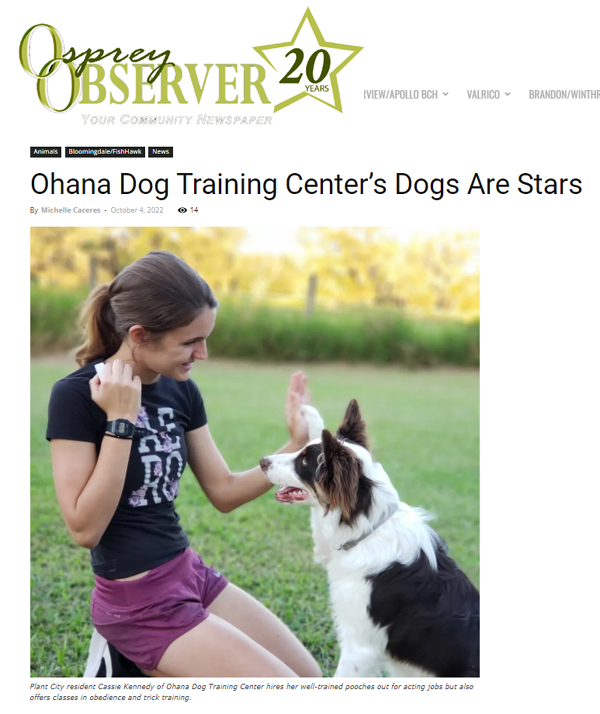
Our trainer Cassie Kennedy has work experience on a a variety of different sets with her own personal dogs, an her dogs have been featured in Lionsgate, Hallmark and YouTube films. She understands the diverse and demanding needs of what is required of a dog on a movie and / or commercial set. Cassie has also performed in numerous live shows with her dogs throughout the United States. She is trainer to Beck the Malinois, star of “R.A.D.A.R. The Adventures Of The Bionic Dog” as well as Ren the Border Collie who plays “Barkley” in Music Club Kids! The most important things for any dog to know prior to going on a set for the first time include basic obedience skills like sit, down and stay. Dogs should also be well socialized to people and other animals that could possibly be on set. Additionally, your dog should also know tricks and behaviors such as going to a mark on cue, barking on command, coming when called, and possibly other tricks including digging, scratching, growling on cue, etc.

(Video description: our dog Beck was featured in “R.A.D.A.R. The Adventures of The Bionic Dog”)

Atlas the Golden Retriever has been featured in numerous commercials such as advertisements for Bayside Sod, Home Shopping Network, BayFirst Bank, John Deere Tractors, Beneva Insurance Company and also plays the role of “Woody” in Hallmark special entitled “Moonlight Bay” (which will be released this upcoming summer)..  Once you are finished with this class, you will not only know the tricks of the trade and important skills for set, but your dog will also know some of the most common behaviors that are needed to be featured on the big screen. An AKC Trick Dog Test will be administered to your dog following the completion of our canine acting and tricks workshop.

(Video description: Attie’s first ever commercial he filmed at just nine months old)

Learn more about our upcoming Canine Acting and Tricks classes or learn about the AKC Trick Dog Titling program by clicking here

Sign Your Dog Up For A Board And Train With Us

Fill out my online form.

Handling Prey Drive in Your Dog

Let’s talk about…
 
Prey drive!
 
What is prey drive?
 
Prey drive is defined as “an overwhelming desire to chase things.” This may include small furry animals, other dogs, bikes, cars, etc. Prey drive can be dangerous if your dog has not been trained to recall off prey.
 
So, how can we help limit and reduce the risks of prey drive? Keep your pets leashed while out in public to prevent them from practicing chasing behaviors.
If you have a new puppy, you can help desensitize your puppy to movement every time something moving passes by them, and they look at it calmly without reacting, give them a treat.
 
This will help teach your puppy to look to YOU for guidance in overwhelming environments.
 
If your dog isn’t wanting to take treats, is still reacting to cars, bikes, other dogs, etc. Try taking a few steps back. You can also use your body to block their field of vision to help them settle down, as well as gentle reminder with the leash that you are still there. You will also want to use “high value” treats, which will be the food that your dog finds to be the most reinforcing. This should be a special treat that your dog only gets when they respond calmly to the stimulus, and also something the dog finds more reinforcing than chasing the stimulus.
 
Remember, it’s okay to feel frustrated when dealing with a dog with prey drive. But also please remember that these behaviors are common in many breeds, it is our responsibility to show our dogs the way to act in public and show them there IS another way.


Paddleboarding With Your Dog in Florida

Paddleboarding with your dog in Florida can be a fun and exciting way to bond with your furry companion while enjoying the beautiful scenery. One of the best places to paddleboard with your dog in Florida is Anna Maria Island. With its crystal clear waters and beautiful beaches, it’s the perfect spot for a paddleboarding adventure with your dog. Another great location for paddleboarding with your dog in Florida is Phillipe Park. This park offers a serene and peaceful setting for you and your dog to explore, and it’s also a great spot for beginners to learn how to paddleboard.

Safety is of the utmost importance when paddleboarding with your dog, and it’s important to make sure your dog is wearing a life jacket. There are many life jackets available on Amazon specifically designed for dogs, such as the Ruffwear K9 Float Coat, which is designed to keep your dog safe and secure while on the water.

When it comes to paddleboards, there are many options available on Amazon. Some popular options include the iROCKER Cruiser Inflatable Stand Up Paddle Board, which is great for beginners and experienced paddleboarders alike, and the FunWater SUP Inflatable Stand Up Paddle Board Ultra-Light Inflatable Paddleboard, which is a great option for those who want to take their dog on a paddleboarding adventure.

In summary, paddleboarding with your dog in Florida can be a wonderful way to bond with your pet while enjoying the beautiful scenery. Some of the best locations for paddleboarding with your dog in Florida include Anna Maria Island and Phillipe Park. Remember to prioritize safety by ensuring your dog is wearing a life jacket and choosing a suitable paddleboard from Amazon.

Wishing you and your pups a safe and fun adventure!

The Benefits Of Hiking With Your Dog

Hiking with your dog can be extremely beneficial for both you and your canine companion! After all, what’s better than getting outside and experiencing the sights, smells & sounds of nature? 

One of the benefits of hiking with your dog is that it offers great exercise for both you and your pup. It can improve your sense of balance, as well as your heart health. However, it is important to always know your surroundings of where you are hiking, and to come prepared with appropriate supplies. If it’s only a hour one hike, a backpack with enough water for you and your furry friend should suffice. However, if it’s a longer hike, you may also want to bring a first aid kit, snacks for you and your pup, and a towel in case you or your hiking partner get wet. For your dog, you will want to bring treats, a leash, and an appropriate collar or harness.

Hiking also helps boost your creativity and mood. Feelings of anxiety and fatigue may greatly be diminished after a nice long hike. Likewise, it can be beneficial to your dog’s mood to allow them to sniff all the interesting smells in nature. Dogs have up to 300 million olfactory receptors. So allowing your dog to sniff along the trail on your hikes will help keep them mentally stimulated and happy. So with all of that being said, it stands to reason that if hiking is good for stress relief and your mental well-being, it’s also would be great for your dog’s. 

Some safety tips to remember when hiking with your dog include remembering to hydrate and stay aware of your surroundings. If your dog is off-leash, please be sure they have been trained a reliable recall and that it is safe to do so in your environment. You always want to be on the lookout for wildlife, as to ensure that your dog does not stumble upon it without realizing or try to chase after any wild animals. It is also important to be aware of any plants that could harm your pet, Poison Ivy has three leaves, so be careful not to touch it or allow your dogs to touch it for their safety.

Thanks so much for checking out today’s blog post.

Until next time…HAPPY TRAINING!!

Using An E-Collar To Train An Off-Leash Recall

One of the most controversial and misconceptualized topics in the dog training community is the use of the electric collar. Electronic collars, or “e-collars” as have they have been dubbed by trainers, can be useful tools for a number of reasons and in a variety of different situations. These tools can be extremely beneficial to dogs if conditioned properly to the collar beforehand. Always start by consulting with a professional trainer to determine whether this is the right tool for you and your dog.

How To Condition An E-Collar Properly

First and foremost, it’s important to properly condition your dog to respond to the collar. Start by giving your dog treats and rewards when they feel the stimulation from the collar, and gradually increase the level of stimulation. By pairing the stimulation with positive reinforcement, your dog will learn that the collar is a good thing and will be more likely to respond to it.

Once your dog is properly conditioned to respond to the collar, you can start using it to train specific behaviors. For example, if you want to train an off-leash recall, start by having your dog on a long leash and giving them the recall command. If they don’t respond, give a gentle stimulation from the collar to get their attention and repeat the command. When your dog comes to you, reward them with treats and praise.

As your dog becomes more confident and reliable with the off-leash recall, you can gradually decrease the length of the leash and eventually remove it altogether.

It’s important to remember that e-collars are not harmful to dogs if used properly. In fact, in certain situations, such as if your dog is lost or in danger, an e-collar can actually help save your dog’s life by allowing you to quickly and easily get their attention and recall them to safety.

There are several reputable brands of electronic collars available on the market, including the Mini Educator and Dogtra collars. These brands are known for their high-quality construction and reliable performance.

In conclusion, an electronic collar can be a valuable tool for dog training, but it’s crucial to use it properly and with the proper conditioning. When used correctly, e-collars are not harmful to dogs and can even help save your dog’s life in certain situations. If you’re considering using an e-collar for your dog, make sure to educate yourself and seek the guidance of a professional dog trainer if needed.


(You can buy a Mini Educator by clicking the link above)!!